Report Claims Property Boom Coming for West Kensington
Three local schemes make up London's largest regeneration hub
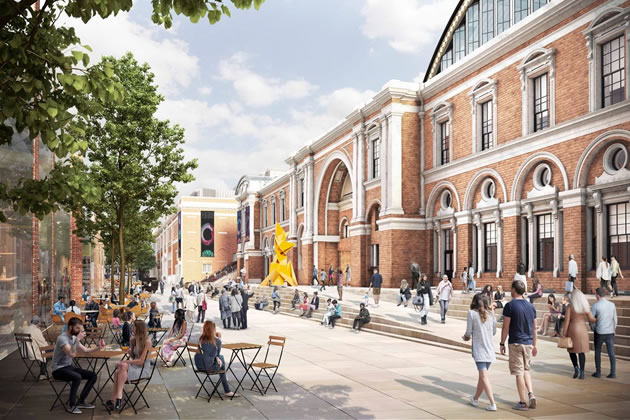
A visualisation of the completed walk way by Kensington Olympia
September 21, 2026
A research report from analytics firm PriceHubble is describing West Kensington as London's largest current regeneration hub and claiming it is on the cusp of a surge in property prices.
It counts 62 acres of former exhibition, event and housing land across three sites: Earls Court (44 acres), Olympia (14 acres) and 100 West Cromwell Road (4 acres). Together they carry a projected gross development value (GDV) of £11.8 billion, which is bigger than the Battersea Power Station scheme at £9 billion. The report estimates that this "regeneration ripple" could add 2.2% to 2.9% a year to local property values above the rise for the rest of the area equating to an 8% premium.
The report was commissioned by SevenCapital, an investor-developer which is one of several firms involved in the regeneration so may have stake in a positive picture being created for the area. The report is accompanied by the company’s chief operating officer urging people to get in ahead of the predicted rise in values by buying flats in its development on the Cromwell Road.
The 8% claim is arithmetic rather than a forecast. Adding the 5.2% historical borough average to the projected premium of 2.2% to 2.9% gives 7.4% to 8.1%, and that calculation rests on three assumptions.
The first is that the past will repeat itself, yet a 10-year average is not a prediction, and prime central London has seen several periods of weakness and tax changes over that time.
The second is that West Kensington will track the borough, even though the borough average is heavily shaped by far more expensive areas. The report itself says apartments in West Kensington average just over £500,000, against roughly £1.25 million in Kensington and £1.35 million in South Kensington, and there is no obvious reason a much cheaper market should follow the same trend line. The third is that the regeneration premium simply stacks on top of the baseline, with no discussion of how the two interact. The body of the release is also more cautious than the headline, saying the ripple "has the potential" to generate an uplift, and the headline drops that hedge.
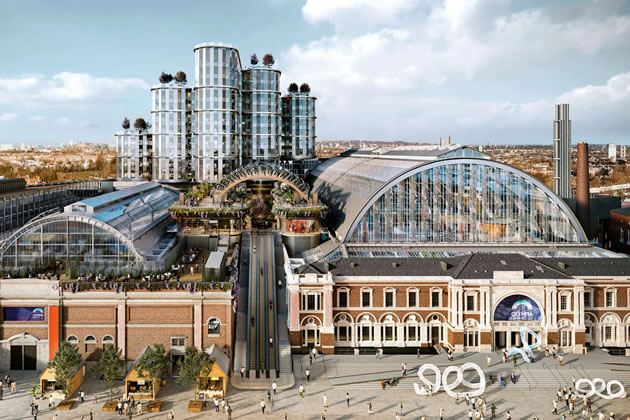
A visualisation from the developer of the completed Olympia project
The 2.2% to 2.9% range is supported by two comparators: King's Cross, which showed a 2.1% annual premium during its 2008 to 2015 redevelopment, and Battersea Power Station and Nine Elms, which showed 4.5% between 2013 and 2022. The projected range sits conveniently between the two. Two cases make a small sample, and both are well-known successes. Schemes that stalled, delivered slowly or failed to lift surrounding values are less likely to be chosen as benchmarks. Nine Elms in particular has been widely discussed for slow sales and affordability problems, so a premium measured against the borough average may reflect its starting position as much as the effect of the scheme. Each premium was also measured against a different baseline, which makes the comparison rough.
The King's Cross and Nine Elms premiums accrued over many years of delivery. In West Kensington, Earls Court Phase One is not due for first occupation until 2030 and Phase Two runs to 2041. Years of construction may weigh on the area before the benefits arrive, and it is unclear why the uplift would fall neatly inside a five-year window.
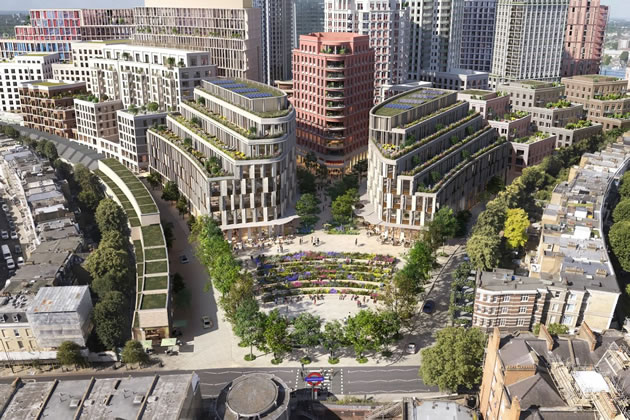
A visualisation of the Earl's Court scheme which will not be complete until 2041 at the earliest
The report talks of "genuine scarcity" while describing more than 4,400 new homes arriving in a compact area. Extra supply can moderate prices as well as raise them, particularly if many units are sold to investors and let out at the same time. The "convergence" thesis, that lower-priced West Kensington will move towards Kensington and Chelsea values, is asserted rather than demonstrated. The report attributes the price gap to the area's stalled history, but other factors probably play a part, including the age and size of the housing stock, distance from established prime streets, and transport infrastructure. Regeneration may narrow the gap, but the release offers no evidence of by how much. Comparisons with Belgravia, Knightsbridge and Chelsea are also less useful than comparisons with nearby new-build schemes, because these are different products in different markets.
The report uses Royal Borough of Kensington & Chelsea data as its benchmark, yet Olympia is generally understood to sit in the London Borough of Hammersmith & Fulham, as does the traditional West Kensington district, and the Earls Court site is thought to straddle the boundary. If parts of the regeneration area fall outside the borough being used as the yardstick, claims such as £3.8 billion added to the borough's economy and 32,500 jobs "in the Borough" need careful reading. "West Kensington" also appears to be a label covering an area many would simply call Earls Court and Olympia.
GDV is a sales projection, not a measure of investment or public benefit, and it depends on future prices. Comparing a 15-year, partly unbuilt pipeline with the GDV of schemes that are largely complete makes the ranking less solid than it looks. The "largest" claim also depends on the comparison list, which includes Battersea, Canary Wharf, Queensway, Elephant & Castle, Mayfair and King's Cross but omits large schemes such as Old Oak Common, the Royal Docks and Greenwich Peninsula. The headline says "London's largest" while the body says "Inner London's." The job and economic figures come without detail: it is unclear whether the 32,500 jobs are gross or net of displacement, whether they include temporary construction work, or whether the £3.8 billion is a one-off or annual figure. Numbers like these often originate in developers' own planning documents. Even "derelict" is loose, since acreage depends on how sites are defined and some of the land was in active use as an events venue for much of the period described as decline.
The investor case rests on gross rental yields of 4.6% in West Kensington, against roughly 4.0% to 4.5% in comparable prime areas, plus rental growth of around 4%. Gross is not net, however. After service charges, management costs, void periods, maintenance and landlord tax, the gap shrinks or disappears, and the margin over Belgravia is just 0.1 percentage points. A higher yield can also signal higher risk, or simply reflect lower prices. The tenant statistics, which cover renters working within five minutes of home, average incomes near £80,000 and upper-quartile incomes above £226,000, describe Kensington & Chelsea as a whole rather than the new developments, and averages of this kind are skewed by very high earners. Yields based on the area's current, largely older stock may not carry over to new apartments bought at launch prices.
The other comparisons are similarly limited. The service charge figure of £14.5 per sq ft, against £18 to £22 in ultra-prime London, sets a new development's projected costs against a more amenity-rich segment. Charges on new schemes often rise once buildings are occupied, and 100 Kensington includes a health club, pool and concierge, which normally cost money to run. The retail claim, that shoppers spent 13% more per shop on Kensington High Street than on the King's Road between January and May 2026, covers five months, an unspecified measure and a location outside the regeneration area, and its link to property values is unclear.
Finally, the summary says nothing about delivery risk, including financing, construction costs, planning changes and delays across a scheme running to 2041. It doesn't address interest rates, tax changes affecting overseas buyers and landlords, or the possibility that demand for new-build flats softens as many reach the market together.
West Kensington is undergoing a major transformation, and regeneration on this scale often does support local values over time. But the figures are built on a historical average, two carefully chosen comparators and data from a borough which much of the development sits outside.
Like Reading Articles Like This? Help Us Produce More This site remains committed to providing local community news and public interest journalism. Articles such as the one above are integral to what we do. We aim to feature as much as possible on local societies, charities based in the area, fundraising efforts by residents, community-based initiatives and even helping people find missing pets. We've always done that and won't be changing, in fact we'd like to do more. However, the readership that these stories generates is often below that needed to cover the cost of producing them. Our financial resources are limited and the local media environment is intensely competitive so there is a constraint on what we can do. We are therefore asking our readers to consider offering financial support to these efforts. Any money given will help support community and public interest news and the expansion of our coverage in this area. A suggested monthly payment is £8 but we would be grateful for any amount for instance if you think this site offers the equivalent value of a subscription to a daily printed newspaper you may wish to consider £20 per month. If neither of these amounts is suitable for you then contact info@neighbournet.com and we can set up an alternative. All payments are made through a secure web site. One-off donations are also appreciated. Choose The Amount You Wish To Contribute. If you do support us in this way we'd be interested to hear what kind of articles you would like to see more of on the site – send your suggestions to the editor. For businesses we offer the chance to be a corporate sponsor of community content on the site. For £30 plus VAT per month you will be the designated sponsor of at least one article a month with your logo appearing if supplied. If there is a specific community group or initiative you'd like to support we can make sure your sponsorship is featured on related content for a one off payment of £50 plus VAT. All payments are made through a secure web site. |